queue_music

Afrobeat Artists: Who to Know, From Fela Kuti to Today
The artists to know in Afrobeat start with Fela Kuti, who created the genre in the 1960s and 70s. They continue with the Afrobeats stars who took West African pop worldwide: Burna Boy, Wizkid, Davido, Rema, Asake, Tems and Ayra Starr. The two spellings mean different things, and knowing the difference makes every playlist and every artist profile easier to follow. Here is who matters, what each is known for and where to hear them.
TL;DR
- Afrobeat (no “s”) is Fela Kuti’s 1960s-70s fusion of West African rhythms, highlife, jazz and funk. Afrobeats (with an “s”) is the newer West African pop sound that mixes in hip-hop, R&B and dancehall.
- The biggest names today are Burna Boy, Wizkid, Davido, Rema, Asake, Tems, Ayra Starr and Tiwa Savage.
- South African artists such as Tyla and the amapiano producers now shape Afrobeats production and charts.
- Interviews show younger artists extending the Afrobeat lineage rather than leaving it behind.
- Blue Radio streams Afrobeat, Afropop, Amapiano and Bongo 24/7, so you can hear these artists in context.
Table of Contents
- Afrobeat vs. Afrobeats: the difference in one minute
- The pioneers: where Afrobeat artists begin
- The global stars of Afrobeats
- Amapiano and the wider African picture
- What the sound is doing now
- What artists say in interviews
- How to start listening
- Our view: Afrobeat is a family, not a ranking
- Hear them on Blue Radio, or get your own music heard
- FAQ
- Sources
Afrobeat vs. Afrobeats: the difference in one minute
Billboard separates the two clearly. Afrobeat is a 1960s genre pioneered by Fela Kuti, blending West African percussive rhythms, fuji and highlife with American jazz and funk, often with political lyrics. Afrobeats is a West African popular style that emerged in the 2000s and draws on hip-hop, R&B and dancehall.
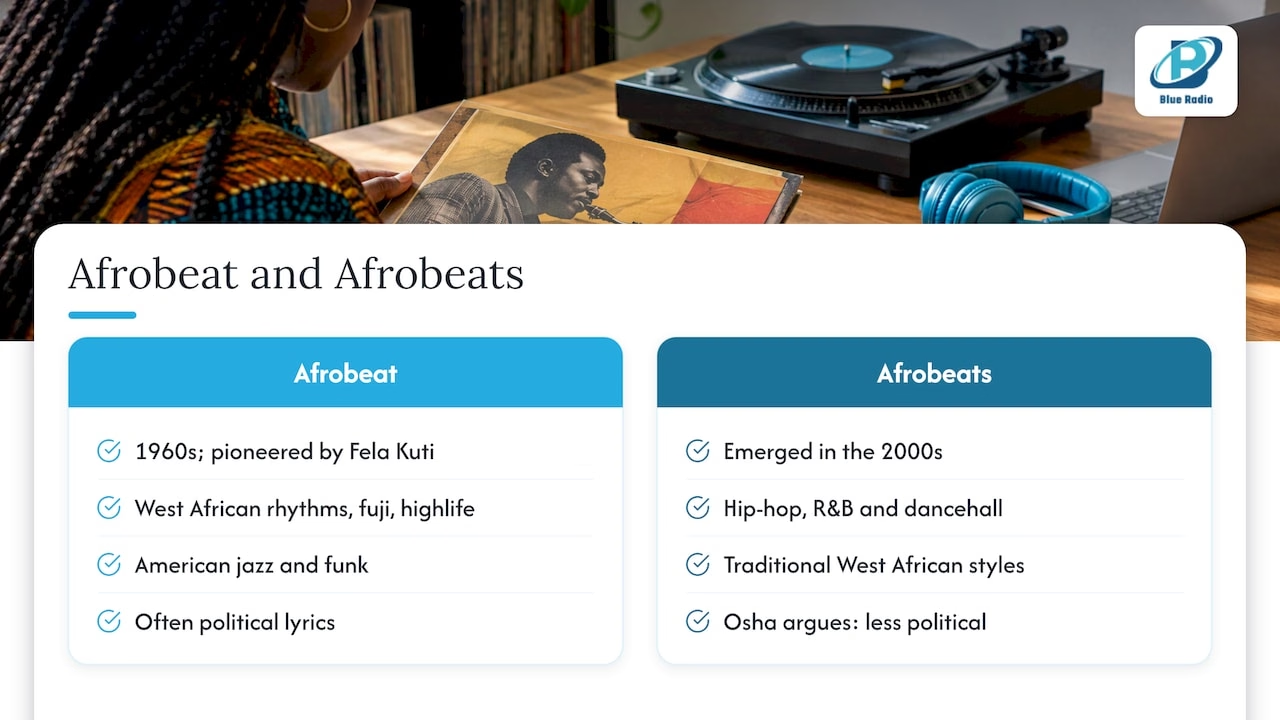
BBC News describes the same split: Afrobeat as the movement Fela created, and Afrobeats as a fusion of traditional West African styles with Western pop, rap and dancehall.
The industry now treats them as separate. Billboard launched its U.S. Afrobeats Songs chart in 2022, two years after the U.K. chart, and the Recording Academy introduced the Best African Music Performance category in 2024.
Some writers see a gap in ambition. Nigerian analyst Sanya Osha argues in The Elephant that Afrobeats is less political and less musically ambitious than Fela’s Afrobeat, since today’s producers can work from beats rather than mastering traditional instruments. Others see something different. Guardian.ng’s Daniel Anazia calls Afrobeats’ rise a masterclass in cultural fusion that feels like home to listeners wherever they are from.
Most listeners just say “Afrobeat” for both, and search results mix them. This guide covers both lineages.
The pioneers: where Afrobeat artists begin
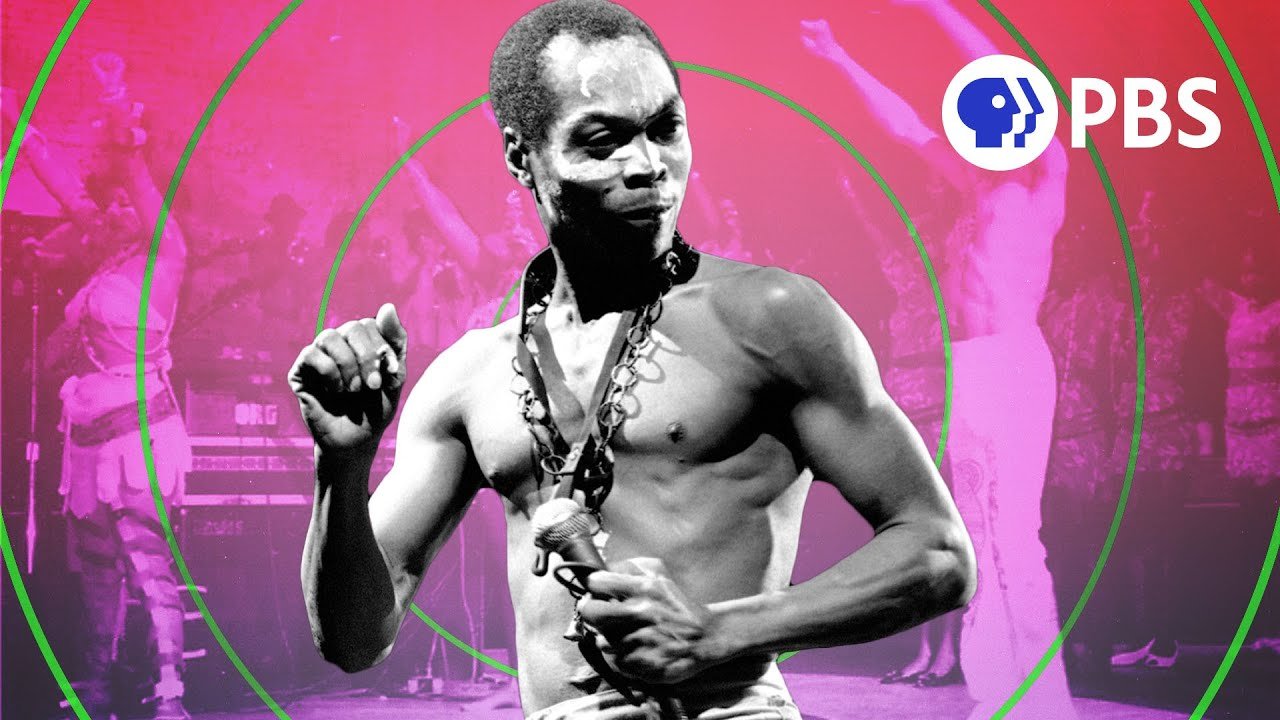
Fela Kuti, the originator
Fela Kuti is the name behind the genre. He studied classical music in England, played in jazz clubs, lived in London in the 1950s and 60s and in Los Angeles in the late 1960s, then returned to Nigeria and built Afrobeat from what he had absorbed.
His reach has lasted. The official Fela Kuti site sells reissue box sets and digital music, and carries news on his Grammy Lifetime Achievement Award, the New Afrika Shrine and the Kalakuta Museum. If you want a starting point, the tracks on his official store include “Zombie” and “Shuffering And Shmiling (part 2)”.
Femi Kuti and the next generation
Fela’s son Femi Kuti carries the sound forward. BBC News notes that Fela played Glastonbury in 1984 and Femi played the festival’s Pyramid Stage in 2024, which says a lot about how the genre’s standing has grown over four decades.
2Baba and the road to Afrobeats
The bridge between Fela’s era and today’s pop sound runs through artists like 2Baba. Grammy.com traces Afrobeats’ commercial rise to his “African Queen”, which won the 2005 MTV Europe Music Award for Best African Act and became the first Nigerian pop song on a U.S. film soundtrack.
The global stars of Afrobeats
These are the artists most people mean when they search for famous Afrobeat artists today.
Burna Boy
Burna Boy fuses Afrobeats with reggae, dancehall, hip-hop and R&B. Cultural Reads dates his rise to 2012 and the song “Like to Party”. According to Revolt’s profile, he won the Grammy for Best Global Music Album with Twice as Tall and was the first Nigerian to headline Madison Square Garden, in 2022. Guardian.ng adds that he headlined the London Stadium in 2023, the first African artist to headline a UK stadium.
Wizkid
Rolling Stone Africa names Wizkid the most-awarded African artist, with up to 200 awards and over 10 billion Spotify streams. His “Essence” with Tems and Justin Bieber, along with Made in Lagos, were the first Nigerian songs to reach the Billboard Hot 100 top ten. We have followed his streaming milestones too: read about his 18 million Spotify monthly listeners and 500M Pandora streams.
Davido
Davido’s catalog runs from “Dami Duro” in 2012 to “Fall” and “UNAVAILABLE”, and Revolt notes three 2024 Grammy nominations including Best Global Music Album for Timeless. His album 5ive is the subject of a Mixmag cover interview that covers dancehall features with Shenseea and YG Marley and the amapiano hit “Holy Water” with Musa Keys. In 2026 Billboard reported that he announced his sixth album, ORIADÉ, to mark 15 years in music, and that he made his Coachella debut that April.
Rema and Asake
Rema’s “Calm Down” is described by Revolt as the longest-charting African song per BBC, and he was the first African artist with a 1-billion-stream song on Spotify. Asake sold out the O2 Arena in 2023, and his “Amapiano” was nominated for the inaugural Best African Music Performance Grammy.
Tems, Ayra Starr, Tiwa Savage and Olamide
Tems is the voice on “Essence”. Ayra Starr became the youngest African female artist to pass 100 million YouTube views, for “Rush”. Olamide landed on the Hot 100 with “Peru” alongside Ed Sheeran. Tiwa Savage remains one of the genre’s defining female voices, and you can hear her on “Energy” with Wande Coal and Mavo.
A quick reference
| Artist | Known for | Where it started |
|---|---|---|
| Fela Kuti | Creating Afrobeat | 1960s-70s Nigeria |
| 2Baba | “African Queen”, early crossover | 2000s Nigeria |
| Burna Boy | Grammy win, stadium headlining | Rose to prominence 2012 |
| Wizkid | “Essence”, most-awarded African artist | Nigeria |
| Davido | Chart consistency, 5ive, ORIADÉ | “Dami Duro” 2012 |
| Rema | “Calm Down”, 1 billion Spotify streams | Nigeria |
| Asake | O2 Arena sellout, log-drum Afrobeats | Nigeria |
| Ayra Starr | “Rush”, youngest to pass 100M YouTube views | Nigeria |
Amapiano and the wider African picture
Afrobeats no longer comes only from Nigeria. Guardian.ng describes amapiano as a blend of deep house, jazz and kwaito developed by South African producers in townships such as Soweto, Alexandra and Katlehong in the early-to-mid 2010s. It is defined by a log drum bassline and a pace of 110 to 115 BPM. Names behind it include Kabza De Small, DJ Maphorisa, Mr JazziQ and DJ Stokie.
The crossover is audible. Grammy.com says Asake’s 2022 “Sungba” brought amapiano log drums into the Afrobeats production toolkit.
South African pop star Tyla is the clearest example of the reach. Rolling Stone Africa reports that her song “Water” won the first Grammy for Best African Music Performance in 2024, was the first song by a South African solo artist on the Billboard Hot 100 in 55 years, and was the first by an African solo artist to pass 1 billion Spotify streams. She won again in 2026 for “Push 2 Start”. Her collaboration with Zara Larsson is covered in “SHE DID IT AGAIN”.
Ghana adds its own thread. Highlife and hip-hop meet in Sarkodie’s “Deja Vu” with KiDi and in “Eno Easy” with DopeNation. Dancehall fans will find the Caribbean link on “Lambo” by Mr Eazi, Vybz Kartel and Dre Skull.
What the sound is doing now
Sounds move fast. Grammy.com’s Melony Akpoghene writes that after more than three years of amapiano dominance, the log drum formula started to wear thin, and that Rema’s 2024 “Ozeba” brought the street-born mara subgenre, fed by TikTok, DJ mixes and rave culture, into the mainstream.
The business is growing with it. IFPI’s Global Music Report 2025 found that Sub-Saharan Africa’s recorded-music revenues grew 22.6% in 2024, passing $100 million for the first time, while the global market reached $29.6 billion.
To watch the newest names, use the Afrobeat chart and the entertainment news page. Artists who tour internationally are often announced there first. If live shows are the goal, see our guide to Afrobeats festivals and how to plan for them.
What artists say in interviews
Interviews are the best way to hear how artists see their own place in the genre. Three recent ones stand out.
Producer MagicSticks on Asake. In Clash Magazine, he says he has worked with Asake since 2019. He explains that “Gratitude” took shape when Asake’s vocal diverged from the original beat, so he rebuilt the beat around the song. His process, he says, is constant experimentation rather than a fixed sound.
Obongjayar on genre. Speaking to ABC News, the Nigerian-London artist says his DNA is Afrobeat while he also works as a rock, punk, funk and jazz artist. His second album, Paradise Now, features only Little Simz, on “Talk Olympics”. It shows younger artists building on the lineage.
Simmy on borders. The South African singer tells News24 about her album Fairyland, which is teased by singles including “Siy’nkanyezi” with Zee Nxumalo. She cites Brenda Fassie and Soul Brothers among her influences, and says working with a DJ from Eswatini reminded her that music does not need borders.
The common thread is that these artists describe themselves through lineage and collaboration, not a single label.
How to start listening
A simple path works for most listeners:
- Start with Fela Kuti for the roots. “Zombie” is a good first track.
- Move to Burna Boy and Wizkid for the bridge between Afrobeat’s depth and pop.
- Add Davido, Rema, Asake and Ayra Starr for the current Afrobeats core.
- Explore amapiano through Tyla and the South African producers.
- Follow new releases weekly so the names you know keep growing.
For the last step, a radio stream does what a static playlist cannot: it introduces artists you did not know to look for. Our shows are built around that, with DJs who know the scene, and the lineup includes Afrobeat, Afropop, Amapiano, Bongo and Afro-Highlife. Fresh collaborations turn up in our feature pages too, such as Qing Madi, Zlatan and Eemoh.
Our view: Afrobeat is a family, not a ranking
Lists of the biggest Afrobeat artists tend to freeze the genre at its charts. We think the sound is better understood as a conversation: Fela’s rhythms, Nigerian pop, South African log drums, Ghanaian highlife, Caribbean dancehall and Bongo all feed each other.
That is why we focus exclusively on Afrobeat, Afropop, Amapiano, Bongo Flava and the urban African genres around them. A listener who hears Burna Boy next to an amapiano producer, then a Tanzanian Bongo track, hears how those pieces connect.
Our DJs and scene insiders curate shows for a global audience and the African diaspora, with a 24/7 live stream, schedules, playlists, charts and news in one place. Come for the names you know. Stay for the ones you are about to.
Sito
Hear them on Blue Radio, or get your own music heard
Blue Radio streams Afrobeat and its neighbors around the clock, with scheduled shows, playlists, podcasts and chart listings on myblueradio.com.
If you make music, our promotion plans start with Community Shoutout at $9.30 per month, followed by Brand Spotlight at $29.90 per month and Prime Time Ads at $47.90 per month. You can also submit a song for a one-off $6 fee.
FAQ
Who is the most popular Afrobeat artist in Nigeria?
There is no single answer, but Burna Boy, Wizkid and Davido are the names most often put at the top. Wizkid is described by Rolling Stone Africa as the most-awarded African artist. Rema and Asake lead the newer wave.
Who is the father of Afrobeat?
Fela Kuti is credited as the creator of Afrobeat. He fused West African rhythms, highlife, jazz and funk with political lyrics in the 1960s and 70s. Billboard and BBC News both describe the genre this way.
Who are the big three African artists?
The trio most often named is Burna Boy, Wizkid and Davido. The Elephant calls them the current superstars. Tyla, Tems, Rema and Asake are among those who have joined that level in recent years.
What is the difference between Afrobeat and Afrobeats?
Afrobeat is Fela Kuti’s 1960s-70s genre built on funk, jazz, highlife and political lyrics. Afrobeats is the later pop style that draws on hip-hop, R&B and dancehall. Both are West African in origin.
Where can I find Afrobeat artist news and interviews?
Check our entertainment page for news, and our chart page for what is rising. For longer conversations, the interviews linked above are a good place to start.
Sources
- Best Afrobeats Songs: 50 African Music Classics, Billboard
- Afrobeats: How the music genre made it to the top, BBC News
- How Afrobeat(s) Was Hatched: From Kuti to Burna, The Elephant
- Afrobeats, Amapiano and genres making Africa sing, Guardian.ng
- Fela Kuti official website
- Fela Kuti official products page
- The Evolution of Afrobeats in 10 Songs, Grammy.com
- African Music Stars Winning Globally, Rolling Stone Africa
- 15 Afrobeats artists you should know, Revolt
- Who Are The Best Afrobeat Artists?, Cultural Reads
- Davido is Afrobeats’ perennial joygiver, Mixmag
- Exclusive: Davido Announces ORIADE Album, Billboard
- Afrobeats Go-To Producer MagicSticks Talks Inspiration, Clash Magazine
- Obongjayar on defying genre stereotypes, ABC News
- Simmy talks new album Fairyland, News24
Recommended



Post comments (0)