queue_music

Radio Show Schedules: How To Find Afrobeat, Amapiano & Afropop Shows

A radio show schedule is a weekly timetable that tells you which show plays at which hour. To catch the Afro music you love, read three things on it: the show name, the start time with its time zone, and whether the slot is live or a repeat. On Blue Radio, the shows page lists our shows, and the Listen Now page puts the 24/7 stream one tap away when you do not want to wait for a slot.
This guide shows you how schedules are built, how to turn a show time into your own local time, how to pick out Afrobeat, Amapiano, Afropop and Bongo shows from a long grid, and how to deal with the changes every schedule goes through.
- A schedule is a rolling weekly grid: a show assigned to Monday at 10 p.m. airs every Monday at that time unless the station changes it.
- Always check the time zone first. Many schedules use UTC or the station’s home time, and you have to convert to your own.
- To find your genre, read the show name, the host and the description, then check the Afrobeat chart to hear what is moving right now.
- Schedules change. Look for labels such as live, repeat or special broadcast, and treat the station’s own page as the final word.
- Between shows, the Blue Radio stream plays Afro-centric music around the clock.
Table of Contents
- What a radio show schedule actually tells you
- The two layouts you will see
- Read the time zone before anything else
- How to find Afrobeat, Amapiano and Afropop shows on a schedule
- Live, repeat or on demand: how to tell
- Why schedules change, and where to check
- Build your own listening routine
- Where Blue Radio fits
- Promote your music or brand to Afro music listeners
- Our view: a schedule should serve the listener
- FAQ
- Sources
What a radio show schedule actually tells you
A schedule is simple in principle. According to the Broadcast Radio Support scheduling guide, a station assigns shows to hours across a rolling week. Put a show on Monday at 10 p.m., and it appears every Monday at 10 p.m. until someone edits it. That repeating pattern is why you can learn a station’s rhythm once and then rely on it.
Most schedules show the same handful of fields. The documentation for Radio Studio Docs says entries can carry the broadcast time, the show name, the format and sometimes an image. Scheduling software also tracks technical details. The Radio Station Pro data documentation lists fields for day, start and end times, a last-updated timestamp, and flags for encore (repeat) broadcasts, overnight shows that split across two days, and overrides.
You do not need the software details. You need to know what each piece means for you:
| Field | What it tells you | Why it matters |
|---|---|---|
| Show name | The brand of the program | Often hints at genre or region |
| Host or DJ | Who curates the music | A DJ’s taste is the best predictor of what you will hear |
| Day and start time | When it airs | The core of the schedule |
| End time | How long it runs | Lets you plan around it |
| Time zone | The clock the times use | The most common source of missed shows |
| Live, repeat or special | Whether the slot is fresh | Tells you if you are hearing something new |
The two layouts you will see
Schedules come in two shapes, and recognizing them saves time.
The first is the grid. Days run across the top or side, hours run down the other axis, and each cell holds a show. The Radio Habana Cuba programming page is a clear example: weekdays and weekend days sit in separate columns, with programs and their start and end times placed in hourly rows. Grids are best when you want to see the whole week at once and spot your favorite night.
The second is the list. Shows are grouped by date, one day at a time, which is how Radio Studio Docs describes its list view. Lists are better on a phone, because you scroll through today rather than pinch a wide table.
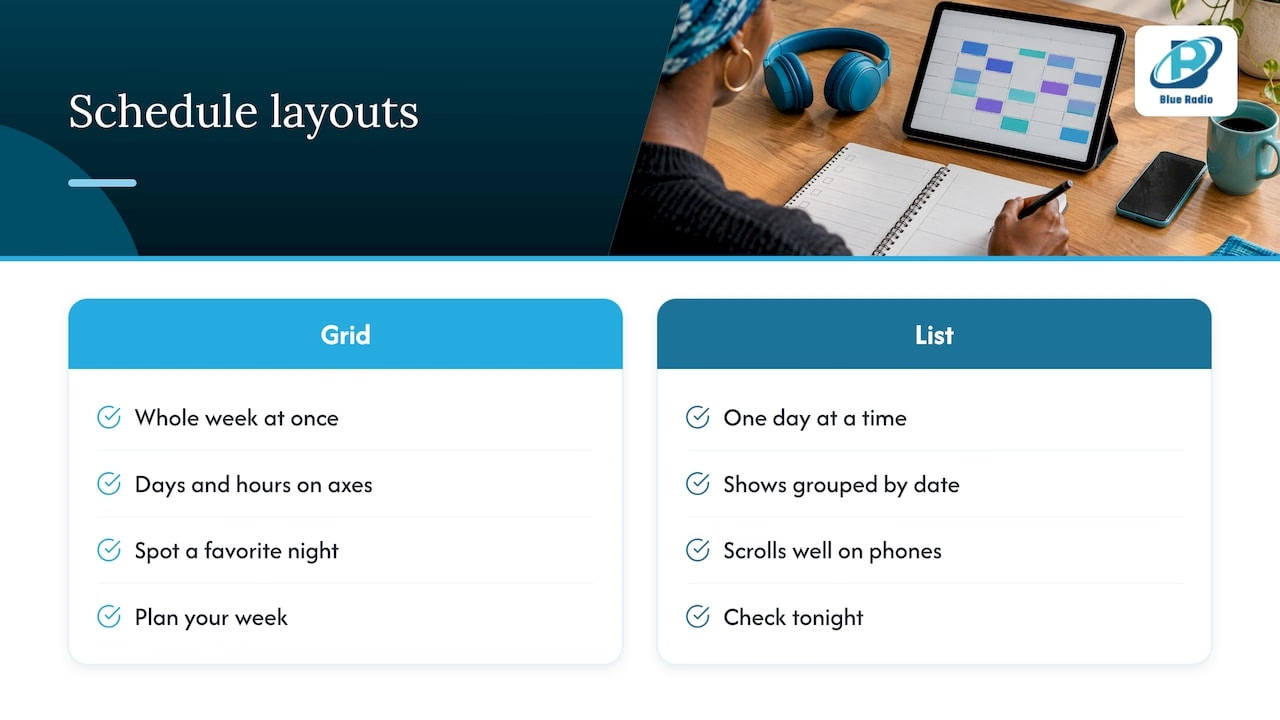
A practical habit: use the grid to plan your week, and the list to check tonight.
Read the time zone before anything else
If you take one thing from this guide, make it this. A show listed at 8 p.m. means nothing until you know whose 8 p.m. it is. Afro music radio has a global audience, from Lagos to London to Atlanta, so the clock a schedule uses might not be yours.
UTC is the standard reference. The National Institute of Standards and Technology (NIST) explains that UTC is a 24-hour system based at the prime meridian near Greenwich. To get Eastern time in the United States, subtract 5 hours during standard time or 4 hours during daylight saving time. NIST’s own example: 1830 UTC is 1330 Eastern, 1230 Central, 1130 Mountain and 1030 Pacific standard time.
A worked example
Say a schedule lists a show at 20:00 UTC.
- In winter (standard time), subtract 5 hours for Eastern: 3 p.m. Eastern.
- Subtract 6 for Central: 2 p.m. Central.
- Subtract 8 for Pacific: noon Pacific.
- In summer, the Eastern offset is 4 hours instead of 5, so the same show lands at 4 p.m. Eastern.
The trap is daylight saving time. A show can seem to “move” by an hour twice a year when it has not moved at all. Your clock changed. If you listen from the US and a show you follow appears an hour off after the clocks change, check whether the schedule uses UTC or a local time first.
Two habits help:
- Write the show’s time in your phone’s calendar with the time zone selected, and let the phone convert it.
- Prefer schedules that print the time zone beside the times. If a page does not say which zone it uses, assume nothing and confirm on the station’s own page.
How to find Afrobeat, Amapiano and Afropop shows on a schedule
Schedules are rarely organized by genre. Most are organized by time, so you have to read between the lines. Here is how listeners who know the scene do it.
Start with the name and the host
Show names often carry the signal. A show named for a region or city tells you the sound it leans toward. On Blue Radio, for instance, AFRO NAIJA is a show page you can open to see what it is about. A host’s name is even more useful. DJs build reputations around a sound, and following one DJ across stations is one of the most reliable ways to find the music you like.
Learn the genre vocabulary
A quick map of the sounds you will see in listings:
- Afrobeat and Afrobeats: West African sounds with a strong dance pulse, the backbone of much of today’s Afro pop.
- Afropop: a broad label for melodic, pop-minded music from across the continent.
- Amapiano: house-influenced dance music with a signature log-drum bassline, rooted in South Africa.
- Bongo Flava: the Tanzanian pop and hip-hop sound, often shortened to Bongo.
- Afro-Highlife: modern takes on highlife, the guitar-led style associated with Ghana and Nigeria.
Blue Radio’s focus covers exactly this list: Afrobeat, Afropop, Amapiano, Bongo and Afro-Highlife, plus related urban African genres.
Use the chart to hear the current sound
A schedule tells you when. A chart tells you what. Our Afrobeat chart is a quick way to see which tracks are leading, so when you open a show you already recognize the songs in it.
Use the entertainment coverage as context
New releases often drive what DJs play that week. Our entertainment section carries music news and artist stories, such as Teni’s album The Wellness Package, the Juls and Projexx Junction EP and DJ Adwoa’s Champions collaboration. If you read about a release on Tuesday, there is a good chance you will hear it on air that week.
Read the show description
A good show page tells you the host, the style and what to expect. If a description is missing, the first ten minutes of the show will tell you more than the title. Keep a short list of the shows that fit your taste, and ignore the rest of the grid.
Live, repeat or on demand: how to tell
Not every slot is a fresh broadcast. Stations fill hours with repeats, and some schedule entries mark the difference. The WEHC weekly schedule from Emory & Henry is one example: it labels some programs as live and notes that its regular schedule can change depending on other live broadcasts.
Here is how to read the signals on any schedule:
| Signal | Likely meaning |
|---|---|
| A “live” tag | The host is on air in real time |
| A “repeat” or “encore” tag | The show aired before and is being played again |
| A late-night or early-morning slot | Often a replay for listeners in other time zones |
| A special-event label | A one-off that replaces the normal show |
| A podcast or on-demand link | Available whenever you want, no schedule needed |
Why does it matter? If you want to hear a DJ debut a new track, catch the live slot. If you only care about the music, a repeat is as good as the original. And if you miss both, an on-demand episode saves the day.
Why schedules change, and where to check
No schedule is permanent. Stations swap hosts, add specials and cover big events. The mechanics are straightforward. The Broadcast Radio Support guide explains that a date-specific assignment can override the normal weekly slot for its date range, and a calendar edit can override both for a single hour or date. So a show can vanish for one Friday and return the next week without anything being “wrong”.
What to do about it:
- Check the day of. Before you plan around a show, open the station’s schedule page that morning.
- Look for the last-updated cue. Some systems record when the schedule was last changed. If the page shows an update date, use it.
- Watch the station’s social channels. Announcements about special shows usually appear there first.
- Keep the stream as a fallback. If a show is moved, the music continues. On Blue Radio, the stream runs 24/7.
A useful mindset: the weekly pattern is the rule, and the exceptions are announced. If you know both, you rarely miss anything.
Build your own listening routine
Here is a simple way to turn a schedule into habit.
- Pick your top three. Scan the week and choose three shows that match your sound, say one Afrobeats show, one Amapiano show and one for the throwback Afro-Highlife mood.
- Convert once. Work out each show’s time in your zone using the UTC method above, and put it in your calendar as a repeating event.
- Add a discovery slot. Pick one show outside your usual taste each week. This is how listeners find a new favorite artist.
- Follow the news. Read the entertainment page on the weekend so Monday’s shows make more sense.
- Share what you find. Social sharing is built into the site, so send a show you love to friends in your group chat.
This works whether you listen from a car commute in Houston, a dorm in Toronto or a flat in London. Because the pattern repeats weekly, you set it up once.
Where Blue Radio fits
We built Blue Radio for people who want Afro-centric sound without hunting across general stations. Our platform delivers live 24/7 streaming of Afrobeat, Afropop, Amapiano, Bongo and Afro-Highlife, alongside curated shows presented by DJs and music scene insiders. The shows page lists the programs, and show pages such as AFRO NAIJA give you each show’s details. Playlists, podcast episodes, chart listings and news sit alongside them, so one site covers the music, the schedule and the culture around it.
If you want a second page of programs, the shows archive continues the list.
Promote your music or brand to Afro music listeners
If you are an artist, label, promoter or brand, the schedule is also where your audience is. We offer three monthly placements on our Promote page:
- Community Shoutout: $9.30 per month
- Brand Spotlight: $29.90 per month
- Prime Time Ads: $47.90 per month
Artists who want their music considered can use the song submission page, where the Submission Fee is a one-off $6.
For questions about which option fits, use our contacts page.
Our view: a schedule should serve the listener
We think a schedule is a promise. When a listener puts a show in their calendar, they are trusting that someone will be there with the right music at the right hour.
That is why we treat Afro music radio as its own category and not as a corner of a general station. Afrobeat, Afropop, Amapiano and Bongo each have their own communities, their own DJs and their own release rhythms. Our shows are curated by DJs and insiders from that scene, and the stream is built around those genres.
Our advice to listeners is simple. Pick the shows that match your sound, learn the time zone once, and keep the live stream open for everything in between. The schedule tells you when the main moments are. The stream makes sure there is always something worth hearing.
Sito
FAQ
How do I find Afrobeat radio shows?
Start with the show names and host names on a schedule, then read each show’s description. On Blue Radio, open the shows page to browse our programs, and check the Afrobeat chart to hear what is leading right now.
What time is a radio show in my time zone?
Find the time zone the schedule uses, then convert. For UTC times, NIST says to subtract 5 hours for Eastern standard time or 4 during daylight saving time. Your phone’s calendar can also convert a time when you pick the zone.
Are radio program schedules the same every week?
Usually the base pattern repeats weekly, so a Monday 10 p.m. show airs every Monday at that hour. Stations can override a slot for a date or a single hour, so check the schedule page on the day you plan to listen.
What if I miss a live show?
Look for a repeat slot or an on-demand episode. Blue Radio also offers podcast episodes and playlists, and the 24/7 stream keeps playing Afro-centric music between shows.
Sources
- Building & Editing Your Schedule, Broadcast Radio Support
- Shows, Radio Studio Docs
- Data API documentation, Radio Station Pro
- Programming, Radio Habana Cuba
- NIST Radio Broadcasts Frequently Asked Questions
- Detailed Weekly Schedule, WEHC 90.7 FM, Emory & Henry
Recommended




Post comments (0)